
Planning often happens in quiet places. Quiet places are not always well connected.
The category drifted online for understandable reasons. Sync is useful. Accounts are convenient for companies. Cloud storage makes many things easier to build, explain, and bill for.
The cost lands on the user in ordinary places: airports, tunnels, trains, hotel rooms with captive portals, conference centers with decorative Wi-Fi, cafés where the network name contains the word guest and the guest is not welcome.
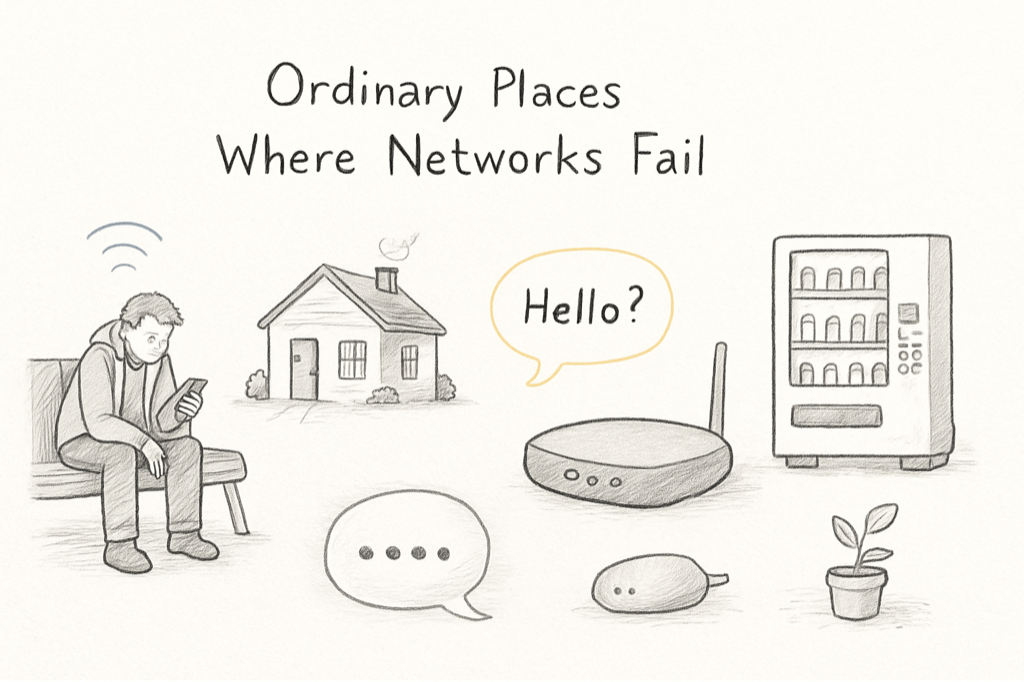
An app that cannot run in a Tuesday-morning train carriage has misunderstood part of its own use case.
Offline is not one thing
“Offline” gets used loosely. It can mean several different things, and the differences matter.
Local-only means the app works without an account and keeps the data on the device. Local-first with sync means the app works without internet, then reconciles when a connection returns. Online-with-cache means the app may look available but becomes uncertain once edits and reconnection are involved. Online-only means the app simply does not open, which is at least honest.
Most frustration lives in the middle, where the app looks offline-capable until the moment the user trusts it.
The test is simple: edit the plan on the ground, open it on a plane, change it again, and see what survives when you land.
A weekly plan should not need permission
Personal planning is too basic to depend on a connection. The week should open because the week is yours, not because a server agreed to participate.
Slate is local-first by default. The app works without an account at all. You can open it, plan the week, add tasks, move them, check them off, and keep going without proving who you are to a network.
If you want the same plan to follow you across devices, you can register an account. Sync is added on top of the local base — the app syncs to the cloud when there is a connection and waits when there is not. The offline state is not treated as an emergency. It is treated as a normal condition.
That distinction changes the trust contract. You are not borrowing access to your plan. You have it.
The Offline pill should be reassuring
Many apps present offline status like a warning light. The app implies trouble. Proceed with caution. Your work may or may not be real.
In a local-first planner, offline can mean the opposite. It can mean the app is still working, still accepting edits, still holding the week. Slate’s Offline pill is a confirmation, not a scolding.
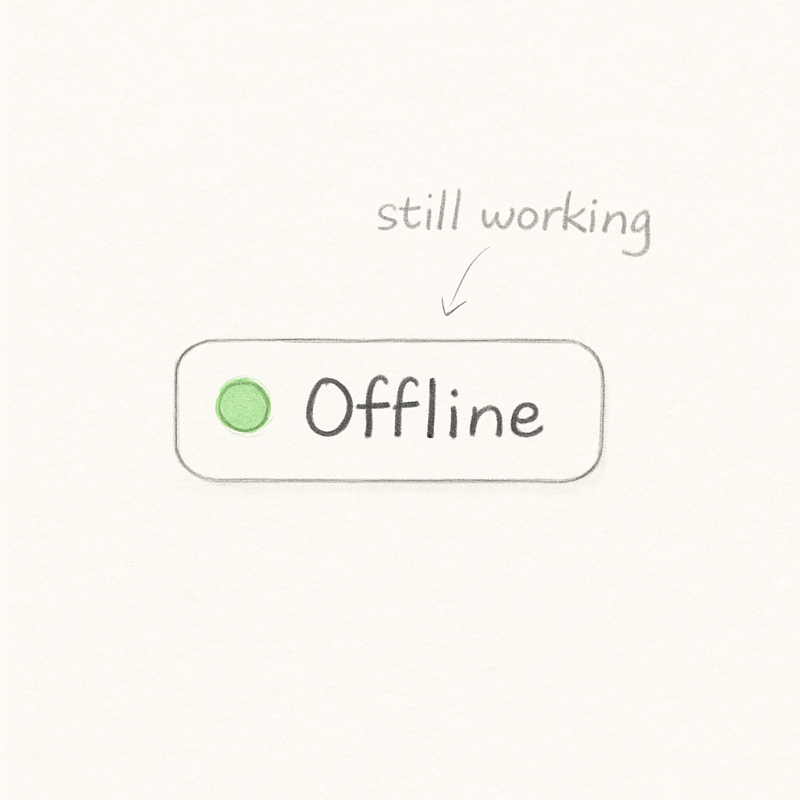
This is especially important for capture. A thought that arrives on a plane or in a tunnel should not have to wait for better conditions. Add it to the Idea Backlog. Move the task. Check off the thing you finished. The plan should remain usable because the plan is local first.
Sync is better when it is not the foundation
Sync is valuable. It is also a poor foundation for the basic act of writing down what you intend to do.
When sync is the foundation, every bad connection becomes a small negotiation. When local work is the foundation, sync becomes what it should be: a way to carry the same plan between devices when the network is available.
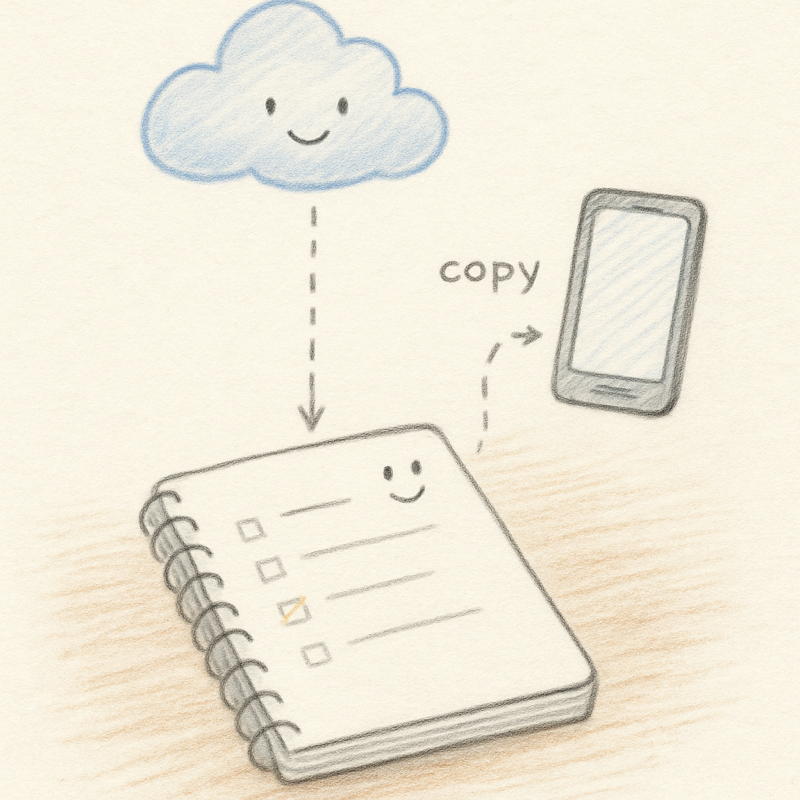
That is the tradeoff Slate makes. The default experience stays local and accountless — the plan is yours, and the device holds it. An account adds cloud sync as backup and as a way to carry the same plan between devices, without making the week dependent on the network behaving itself.
Offline-first is not a nostalgic position. It is a practical one. The app should be there when the user has the thought, not only when the signal cooperates.